Hiking With Ghosts

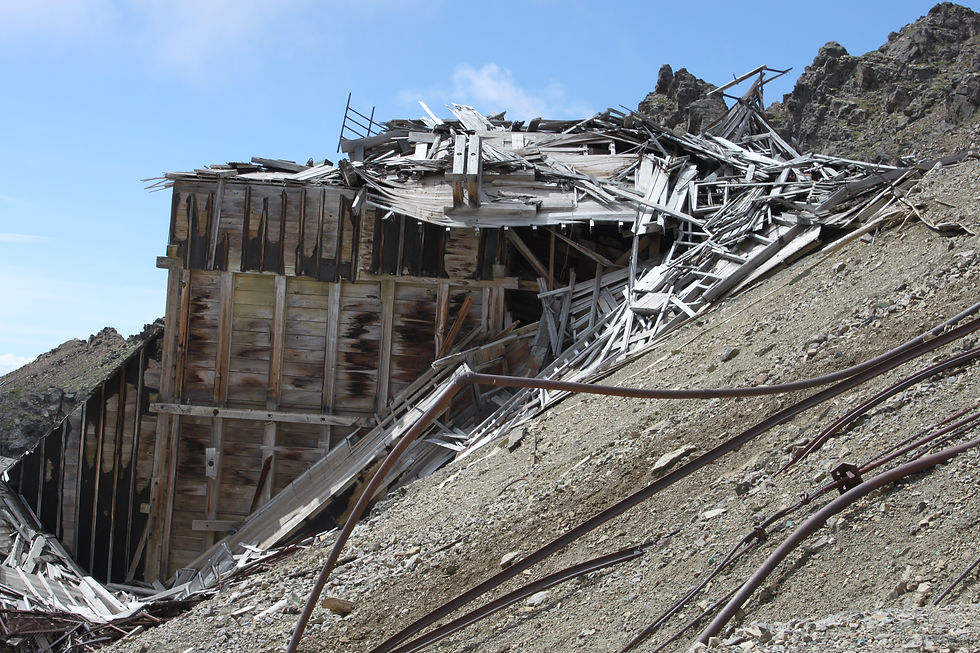
Bonanza Mine, Kennecott, Alaska — © J.L. Dupont
Every mountain trail carries its history, both good and bad. Histories of success and failure, human resilience, life and death. But some are steeped in history more than others. A few years ago, I hiked one of these trails, and though it wasn’t the toughest I’ve ever done, I often had to slow my pace, come to a standstill, not to regain my breath, but to take in the bits and pieces of the past dotting the track.
Why not come along as I spin this little yarn? You won’t regret it.
Start out early before the tourists arrive and the guided tours start, and head for the mountain trail above the village. Walk along the single, empty street and the remnants of the railroad track of what was once this bustling mining town. Can you hear the muted laughter and the chime of the cash register as you walk past the old company store? Some soft groan coming from the hospital and a curse from the workers’ bunkhouse opposite? The whimpering child in the cottage to the right? And there, the old shack on the left, certainly, that curtain in the window just now fell back and you think you caught a glimpse of a pale face surprised at seeing a stranger walking down the street.
Start out early, and you won’t meet a living soul.

Kennecott Mill Town, Alaska — © J.L. Dupont
Although it was an all too familiar fever that first lured prospectors to this far flung, inhospitable corner of the Great North, it wasn’t gold they found that fateful summer of 1900. Instead, they found a mountain decked in green. Copper! The sourdoughs staked their claims, then sold them to the corporate greed of the J.P. Morgans and Guggenheims of this world. By 1911, against all odds, a mining community of some four hundred souls had risen, wedged between a mighty glacier and the mountains, its only connection to the outside world a 196-mile railroad track four years in the making.
Named, and misspelled, after the Kennicott Glacier that snakes its way below it, the company town of Kennecott, Alaska, was ready to write mining history, albeit a brief history. On November 10, 1938, with the high-grade ore bodies depleted and the mines no longer profitable, the very last train pulled out with the last residents on board, turning Kennecott into a ghost town overnight.
But enough history, let the walking do the talking, past the ammonia leaching plant where you sniff the air to try and catch an imaginary whiff of toxic bygones, past the machine shop and the fourteen-story concentration mill cascading down the hill flank, its once incessant guttural rumble of roiling crushed rock and ore now eerily gone silent. Continue down the path and leave behind the deceptively quaint Nordic fairytale looks of the deep red wooden facades with their white-trimmed window frames and eaves. A croak of warning and distress breaks the silence, but when you look back, all you see is a black crow prancing about on a roof, reminding you that back in the days, there wasn’t anything quaint about the hard and dangerous work that went on behind these facades.

Kennecott Concentration Mill, Alaska — © J.L. Dupont
A little further on, a wooden signpost sends you off to the right and the start of the climb to the Bonanza Ridge. The trail loops back above the mining town, and through the gaps in the thick stands of aspen and spruce you catch glimpses of the desolate, lunar landscape of the Kennicott Glacier covered in sleet-grey moraine. Coming out above the treeline, you’re greeted by the gaping maw of the mill, that insatiable mouth that needed constant feeding, the cables of the aerial tramway still intact but motionless since the last of the copper ore buckets swung down the mountain.

Kennecott Concentration Mill, Alaska — © J.L. Dupont
Above is where you’re going now, on a relentless four-mile ascent with an elevation gain of roughly 3,900 feet. The grind and crunch of loose scree and rock underneath your heavy boots breaks the silence, resounds and scatters in the breeze, fools you into looking back. Who’s coming up behind?
But you’ve started out early, and you won’t meet a soul, at least not a living one.
At a crumbling wooden frame of the tramway you pause and wonder. How many miners tramped up and down this path on their way to and from the mines? How many rode the buckets in and out?

Remnants of the aerial tramway system, Kennecott, Alaska — © J.L. Dupont
You haven’t kept track of time and you guess you’ve been walking for about two and a half, three hours, when right below the jagged mountain ridge the forlorn remnants of the Bonanza Mine come into view looking like a storm-battered boat about to sink underneath the crest of a stony wave. Unlike many of the buildings in the village below, the wooden mine structures will not be salvaged. Too remote; too costly. In the end, the tunnel-tortured mountain will get its due and swallow the mine whole, wood, nails and bolts and all.

Bonanza Mine, Kennecott, Alaska — © J.L. Dupont
A last effort takes you up past the crumbling buildings to the ridge where you take in the spectacular view of the Wrangell Mountains. You breathe in deep, letting that feeling of total detachment from the hectic world you left behind engulf you, your hiking efforts rewarded. It’s time for a rest and you find yourself a seat on top of the copper-speckled rocks.

View of the Wrangells and Root Glacier from the Bonanza Ridge, Kennecott, Alaska — © J.L. Dupont
Maybe it’s only the cool breeze on your sweat-drenched back, but when you turn to look down on the mine, you shiver, and you want to shout out that age-old children’s call — “Come out! Come out, wherever you are!” — though you know there’s not a soul who’ll answer. All that meets the eye in the thin swirls of dust below, are the shades of green and blue of the malachite and azurite spectres of the past.

Bonanza Mine, Kennecott, Alaska — © J.L. Dupont
Gone are the men who worked the tunnels, seven days a week, through all seasons, living in a bunkhouse now near to collapsing, taking their meals in a windowless, underground mess hall. They’d be up here for weeks, even months on end. Apart from Christmas and a few public holidays, it is said the miners didn’t come down, unless it was on a stretcher or when they had decided to call it quits.
The old Kennecott cemetery you visited the day before told you some of them never left at all.
Located about a quarter mile from the mill town, the cemetery also told you that almost half of the men buried here were immigrants, an improbable patchwork quilt of individuals from a dozen different nations willing to brave the hazardous mines, a patchwork held together by a single common thread — the hope of a better life.
Nothing much has changed since then, has it?
And graveyards are great storytellers, if you care to listen.
It’s well past noon when you finally come down the mountain. The old mill town has now come to life. Tourists are strolling around, some on their own, some with park guides. Others are taking the trail out of town that leads to the Root Glacier, again, some on their own, others with outdoors guides who’ll take them for a glacier hike. Only a few are heading up the strenuous mountain trail to the Bonanza Ridge, with some of them, you gather from a single glance at their footwear, entirely unprepared.
“Start out early,” you tell yourself and smile.

Bonanza Ridge, Kennecott, Alaska — © J.L. Dupont


Comments